Long-Term Patient Outcomes

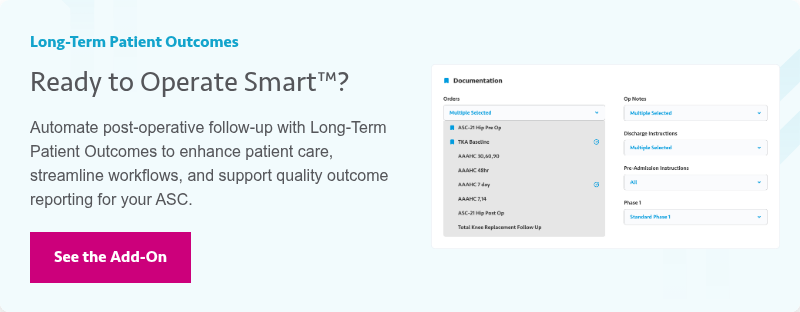
The SIS Complete™ Long-Term Patient Outcomes (LTPO) module gives ASCs an easier, better way to prove that their care makes a lasting difference in the lives of their patients. Three total joint centers have used the LTPO to automate their patient follow-up, allowing them to replace cumbersome, disjointed processes and get more meaningful data on how their patients recover.

worklist configs

Center 1

Before LTPO, this multi-specialty ASC managed long-term follow-up across two disconnected systems: running post-op questionnaires through a third-party platform while documenting in SIS Complete, then exporting everything into an Excel tracker their total joint coordinator maintained manually. With Long-Term Patient Outcomes, that entire process now lives inside SIS Complete.

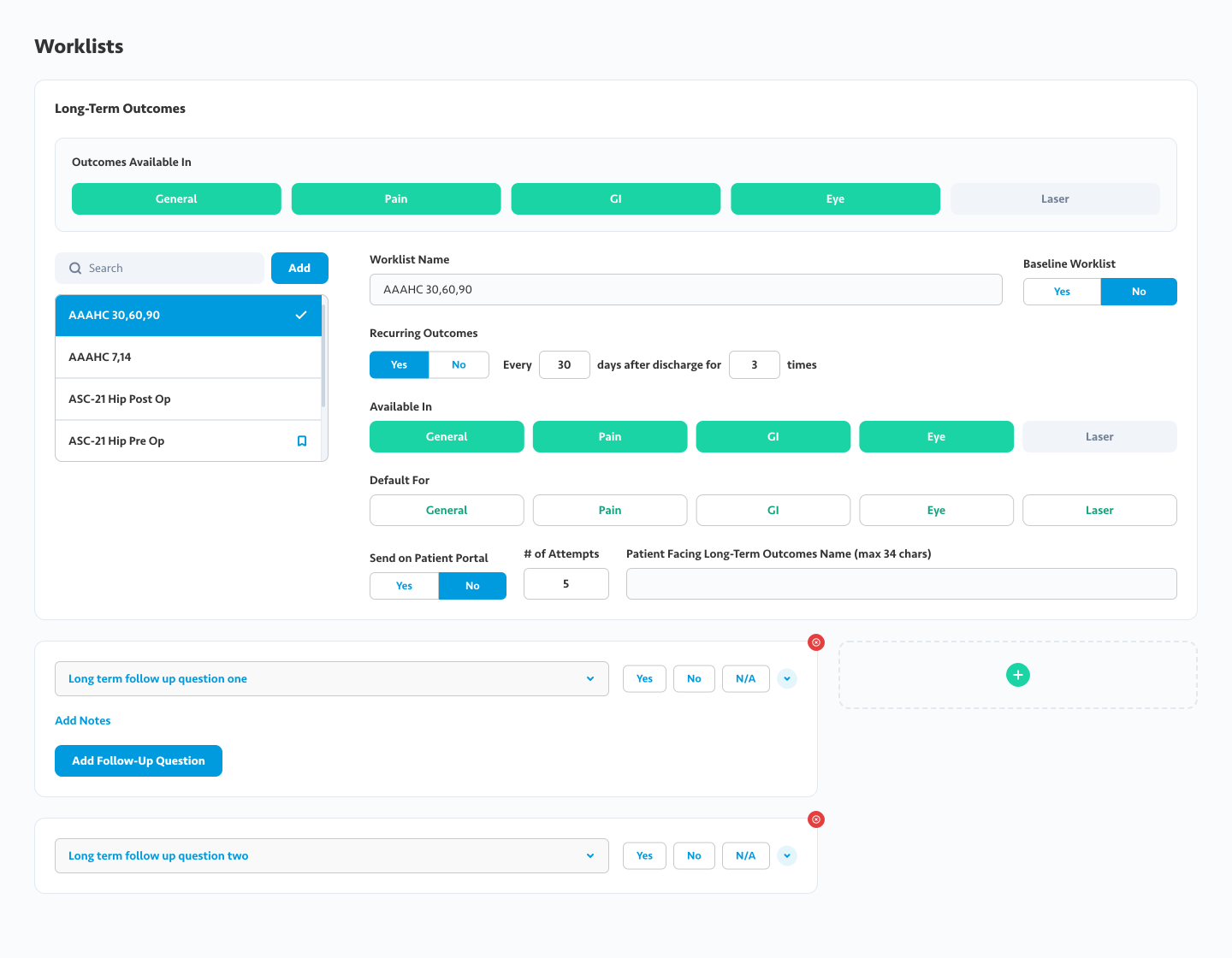
Customized questionnaires for each interval capture the data they need to ensure patients have better health outcomes. Preference card automation assigns the right questionnaire the moment a case is scheduled, and the spreadsheet and second-system logins are gone. They can easily monitor whether patients have completed their follow-up survey, contact those who haven’t, and mark contact attempts directly in SIS Complete, ensuring no patient follow-ups are overlooked.

The result is a single, streamlined workflow that keeps all documentation in one place and frees staff to focus on patients instead of data entry.

Outcomes

By moving follow-up into SIS Complete, this ASC reached approximately 60-70% patient completion of follow-up questionnaires with no additional prompting.

In Their Own Words

Long-Term Patient Outcomes has significantly simplified patient follow-up and outcomes monitoring for our team. The biggest win is keeping everything in one place. We used to bounce between two systems and a spreadsheet just to track follow-up; now it's all in SIS Complete, right where our documentation already lives.

Clinical Informaticist
 

Center 2

This ASC management company implemented LTPO at one of their multi-specialty centers that largely performs total joint cases. They once managed long-term follow-up through a paper-based process that relied on printed schedules, accordion files, paper questionnaires, scanned documents in SIS Charts, and a master spreadsheet for follow-up tracking. Long-Term Patient Outcomes replaced that manual, labor-intensive process with an automated workflow inside SIS Complete.

Preference card automation ensures only the right cases receive questionnaires, and staff now work within the same SIS Charts trackers they already know. For a center performing at this scale, that shift eliminated the files, paper, and scanning while making required follow-up dramatically easier to manage.

Outcomes

A center performing roughly 200 total joint cases per week (10,000+ annually) was able to operationalize required follow-up at scale with minimal setup effort. The experience has gone well enough that they plan to expand LTPO to three additional locations.

In Their Words

Setup was genuinely easy. I wouldn't even call it a heavy lift. What I love is that it fits right into the trackers our staff already use, so there's no additional training required. This is going to be a great addition for the market, and we're already planning to bring it to our other centers.
Director of Healthcare Management Systems
 

Center 3

This single-specialty total joint center had no prior system for meaningful follow-up beyond the initial 24-hour post-op call. Long-Term Patient Outcomes enabled them to build a follow-up workflow for the first time, giving patients additional touchpoints and flagging critical responses for faster intervention.

Setting up questionnaires was easy, with the same standardized follow-up applied across their 1,500 annual total joint cases.

Outcome

Approximately 25-30% of patients completed follow-up surveys without any additional prompting. The center identified a significant trend of post-op constipation among patients taking pain medications. This insight spurred updates to discharge instructions and new patient education materials. LTPO also flagged individual patient concerns — from signs of infection to fall alerts — allowing for timely outreach.

In Their Words

We've been wanting to do meaningful post-op follow-ups for years but didn’t have the tools before. Now, not only are we engaging patients beyond 24 hours, but we're also identifying trends like post-op constipation that are guiding new patient education efforts. It’s good PR for our center and shows patients we care.

Administrator


Prove Your Outcomes Make a Lasting Difference

If your ASC is still managing long-term follow-up with spreadsheets and paper, LTPO offers a smarter path forward, one that lives right inside SIS Complete and is available for a low monthly fee.

Current SIS clients can contact their SIS representative to see how LTPO fits into their existing workflow.

Better follow-up. Clearer visibility. Stronger patient care. That's what it means to Operate Smart.